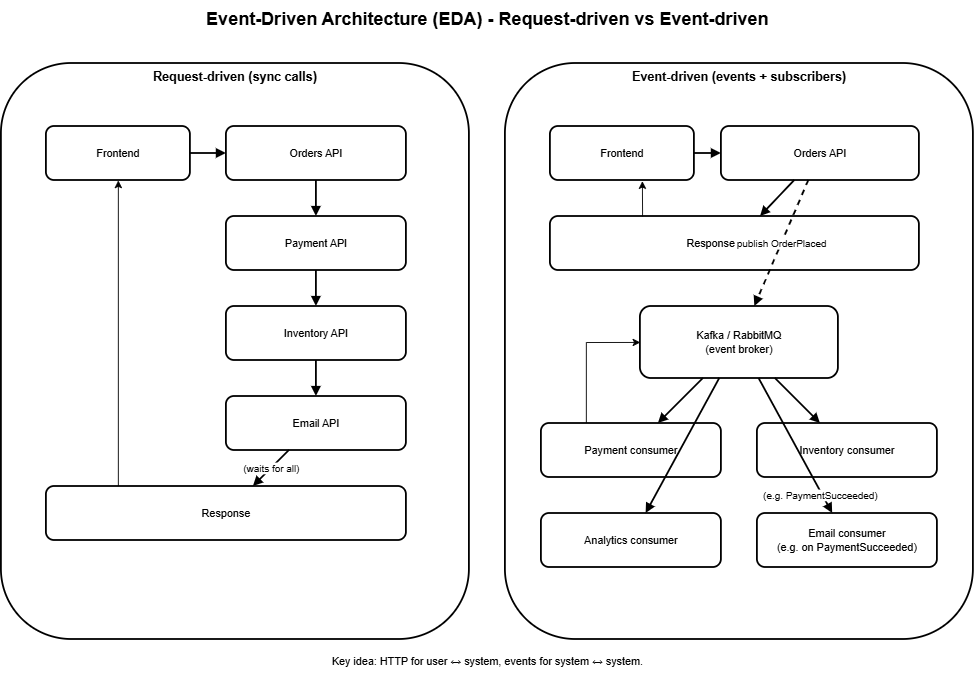
80/20 Of The Week 🗣️ … Event-Driven Architecture (EDA)
If you ever heard stuff like Kafka or RabbitMQ… this is THAT!
Most systems you build start request-driven: User hits an endpoint → Service A calls B calls C → linear and simple
EDA flips it: Instead of “call this service”, you say “something happened” (an event) and whoever cares reacts.
Basically…
- Request-driven = calling people one by one.
- Event-driven = dropping a message in a group chat. People who care (subscribe to it) respond. People who don’t… ignore.
When do you use EDA instead of the regular system (better than the “normal” way)
- One action has many side-effects: like…
OrderPlaced→ payment → inventory → email → analytics → fraud checks - Async is OK (user doesn’t need all work finished in the same request)
- Spiky traffic / bursts: broker buffers, consumers scale
- Multiple teams need to move independently: less tight coupling
When EDA is not needed
- Simple CRUD app: few side effects
- You need strong consistency NOW across services: one transaction, one truth
- Linear apps: no need to overengineer everything even if AIs tell you to some time 😭
Request-driven: Frontend → Orders API → Payment API → Inventory API → Email API → response
Event-driven:
Frontend → Orders API → response
↘ publish OrderPlaced to Kafka
↘ Payment consumer
↘ Inventory consumer
↘ Analytics consumer
↘ Email consumer (for example, PaymentSucceeded)
(I had to google for this arrow emoji lol)
If one request triggers 5+ downstream actions, you already have an EDA-shaped problem 🙂