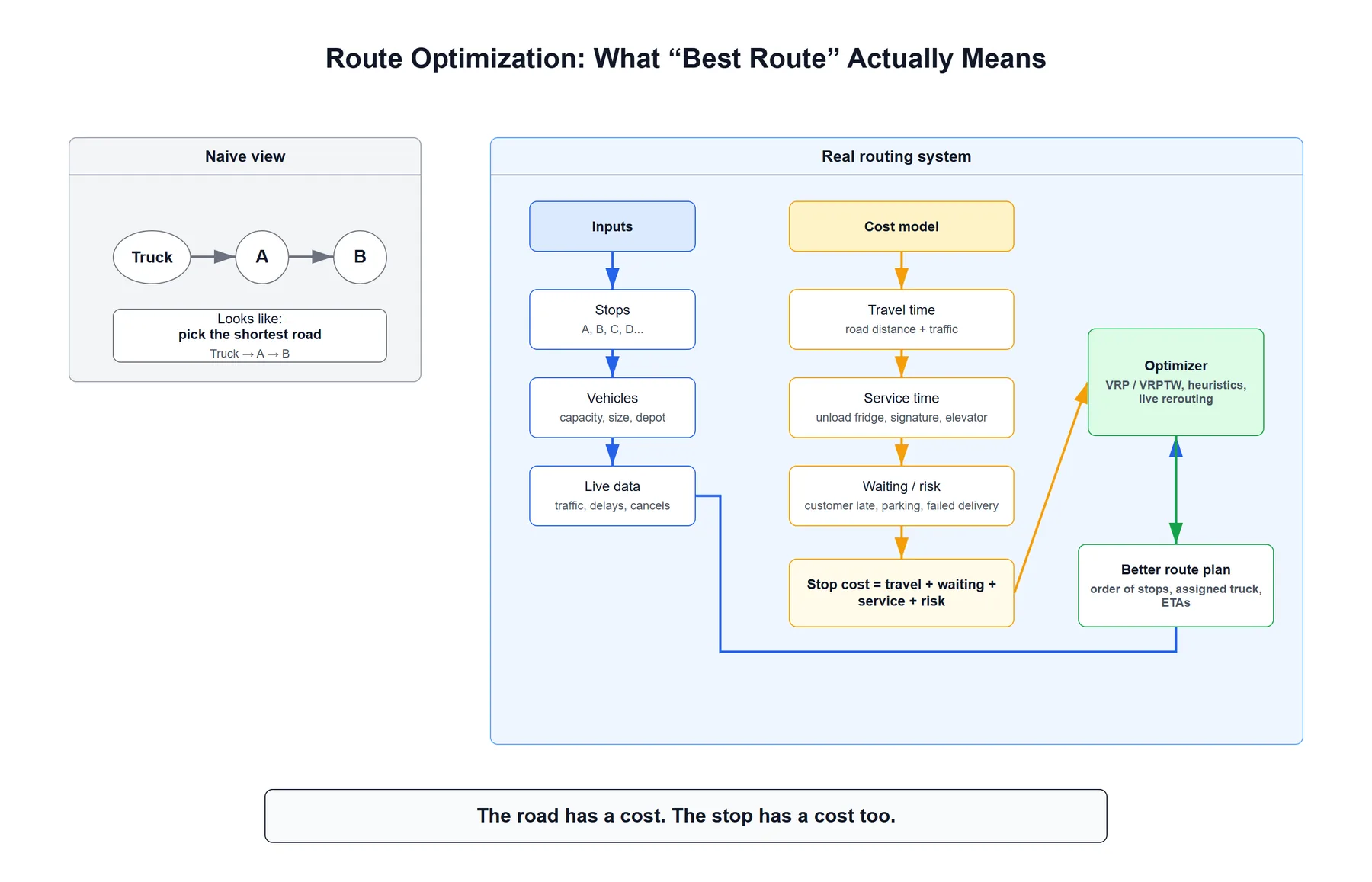
80/20 Of The Week … Route Optimization
I have listened to quite a few mathematicians who ended up very close to IT, and one thing I noticed is how often navigation-like problems show up in their work.
Sometimes that means actual navigation, like maps.
Sometimes it means delivery systems, warehouse movement, field-service planning, taxi dispatching, trucking, scheduling and what not.
On a very abstract layer it sounds kind of simple:
find the best route.
But “best” is doing a lot of work there lol
If you go from one point to another, shortest path algorithms like Dijkstra or A* already make sense.
But delivery routing gets annoying fast because now the question becomes:
“In what order should I visit A, B, C, D, E… with the right vehicle, inside the right time windows, while respecting capacity, traffic, driver hours, unloading time, failed deliveries, and random delays?”
That is where this becomes much closer to optimization than plain navigation.
Example:
Stop A is 5 minutes away.
Stop B is 15 minutes after that.
Looks easy.
But if stop A is a fridge delivery, maybe the driver waits for the customer, finds parking, carries the fridge upstairs, waits for an elevator, gets a signature, or fails the delivery and has to mark it differently.
So stop A was not really “5 minutes”.
It was:
travel time + waiting time + service time + risk
And now the arrival time at B changes too.
That is the part I find interesting. The road between two points has a cost, but the stop itself also has a cost.
Formal terms enter here.
The simple version is the shortest path problem.
The “visit many places” version starts looking like the Traveling Salesman Problem.
Once you add multiple trucks, capacity, depots, deadlines, driver constraints and different delivery types, you are in Vehicle Routing Problem territory.
If customers can only receive deliveries between 10:00 and 12:00, that becomes VRP with Time Windows.
Real systems also reroute during the day.
Traffic changes.
A customer cancels.
One truck gets delayed.
Another truck finishes early.
The plan that was “best” at 08:00 may be kind of bad by 11:30.
So these systems usually mix algorithms, heuristics, live data, and business rules instead of pretending one perfect formula solves the whole thing.
The benefit is pretty direct:
fewer miles, less fuel, better delivery times, fewer missed windows, better vehicle usage, and less human guessing.
UPS ORION is a famous example here. Their route optimization work has been publicly linked to huge reductions in miles driven and fuel used.
So the better way to see routing is:
a constraint problem that happens to involve roads.
And in real logistics, the edge cases are basically the main problem.
#Algorithms #Optimization #SystemDesign #Logistics #VehicleRouting #SoftwareEngineering #Mathematics