80/20 Of The Week … How Instagram Recommendations You
A bit dramatic title but yeah lol
The common idea is that Instagram “knows what you like”.
Kind of.
The more accurate version is that it keeps learning what you are likely to do next.
Watch.
Pause.
Replay.
Comment.
Share.
Save.
Open the profile.
Click “not interested”.
All of those become signals.
So if you keep stopping on gym content, football edits, political arguments, relationship drama, AI videos, cooking clips or whatever else, the system starts building a picture of what usually gets a reaction from you.
And that is where ragebait enters the conversation.
Nobody needs to write a rule like:
“make this person angry”.
The system can learn that certain types of content make people stay longer, comment harder, share faster, or come back again.
Anger is useful from the model’s point of view if anger creates measurable engagement.
Now how does Instagram understand the post itself?
It does not understand it like a human, but it can extract a lot.
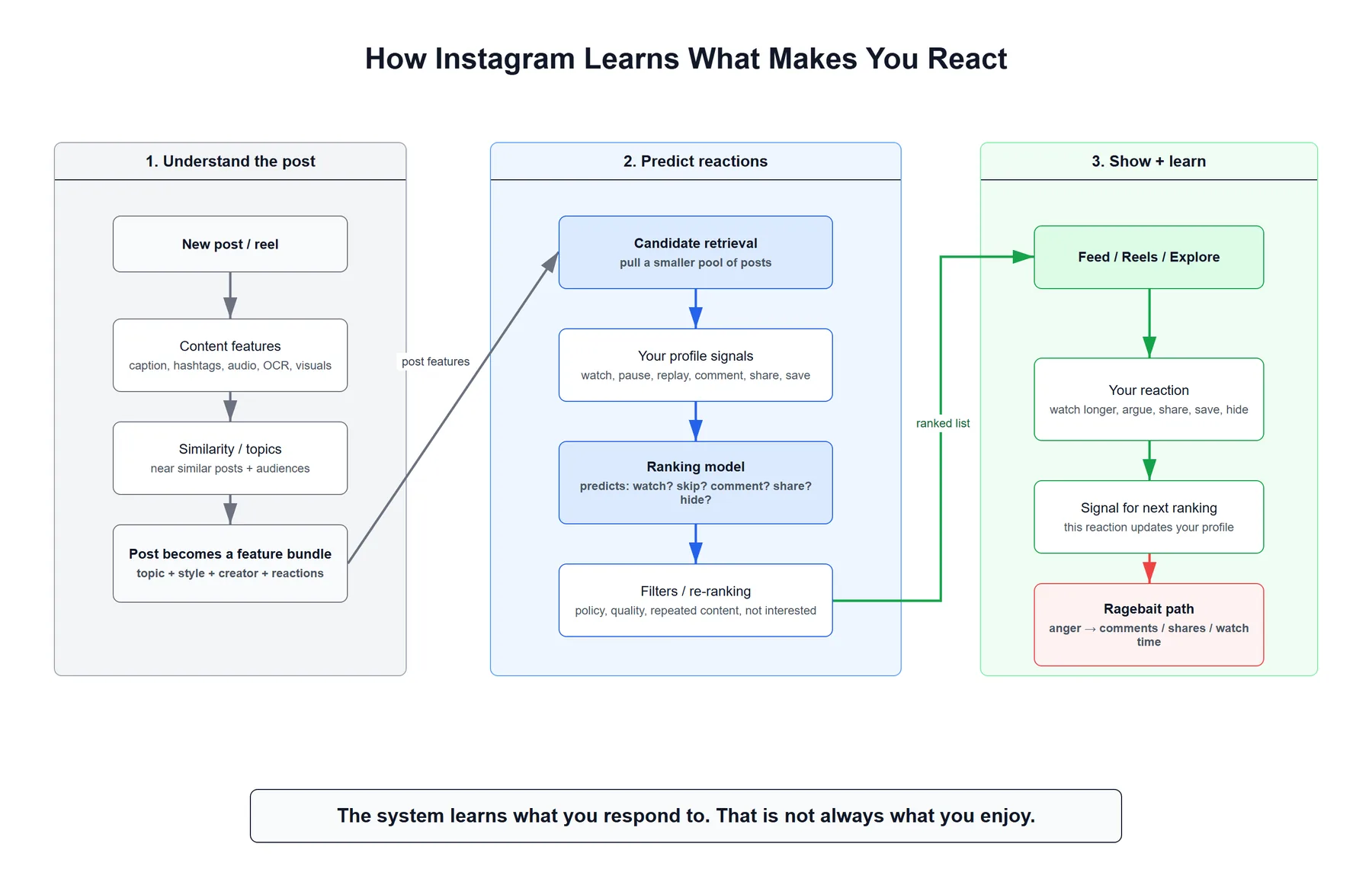
For a post or reel, the system can look at caption text, hashtags, audio, visual objects, faces, OCR text inside the video/image, creator history, topic/category, previous engagement, who usually reacts to similar posts, and embeddings that place the content near similar content.
So a video becomes a bundle of features:
topic, style, creator, audio, language, visuals, engagement pattern, similarity to other posts, and how different groups reacted to it.
Then the recommendation flow usually looks something like this:
First, candidate retrieval.
The system cannot rank every post on Instagram for every user. So it pulls a smaller pool of possible posts from accounts, topics, similar users, similar content, trending items, and previous behavior.
Then ranking.
For each candidate, the model predicts things like:
will this person watch it?
will they skip it?
will they like, comment, share, save, follow, or hide it?
Then filtering and re-ranking.
Some content gets downranked or removed from recommendations because of policy, quality, safety, repeated content, low originality, or because the user said they do not want that type of content.
The final feed is basically the result of all that.
And the annoying part is that the feedback loop is very fast.
You watch one type of post longer than usual.
You argue in the comments.
You send it to a friend.
You check the creator.
Now the system has evidence.
Not proof that you “like” it.
Evidence that it worked on you.
That is why ragebait can spread so well. It creates reactions, and recommendation systems are very good at detecting reactions.
The useful way to see it:
these systems find what you respond to.
And that is not always the same as what you actually enjoy.
#RecommendationSystems #Algorithms #MachineLearning #Instagram #SystemDesign #AI #SoftwareEngineering